
In terms of things to do in Tenby, this (we think) is the absolute best. There are kayak trips, and then there are kayak trips that remind you exactly why you live where you live. This is one of the latter — a route that takes in two centuries of maritime history, one Victorian fort, a secret beach, and enough spectacularI coastline to keep you gawping for the entire paddle. It starts and ends at Castle Beach, and if conditions behave, it ends in a cave. Here’s the full route.
Castle Beach: The Briefing
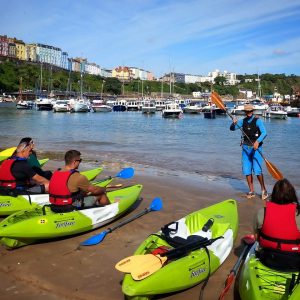 We launch from Tenby Harbour or more usually, Castle Beach, one of Tenby’s quietest and most characterful beaches. At low tide the sand stretches out wide and firm, sandwiched between the limestone bulk of Castle Hill on one side and the long sheer sweep of East Cliff on the other. The beach disappears almost entirely at high tide — one reason we time the trip carefully — but at the right moment, it’s a perfect launchpad.
Above you, Castle Hill rises like the prow of a ship. The Norman castle on its crown dates to the 12th century, though only a modest tower now survives. The hill was once a fashionable promenade for Georgian visitors arriving in what was then one of the most celebrated seaside resorts in Britain. Today it’s a good vantage point for watching your friends try to get into a kayak for the first time. Your guide will deliver a full briefing here — kit check, paddle technique, sea awareness, communication signals. Take it seriously. The sea is what it is.
St Catherine’s Island: Finding Your Paddle
A short paddle east from Castle Beach and you’re in the shelter of St Catherine’s Island — a small but surprisingly substantial tidal island connected to the shore only at low water, when a narrow causeway of sand is briefly exposed. This is where we let everyone find their rhythm, practising turns and bracing strokes in calm, forgiving water away from the main tidal flow.
The island is dominated by its Victorian fort, a squat, purposeful structure completed in 1870. It was one of dozens of coastal forts built following Lord Palmerston’s 1859 Royal Commission, which concluded that Britain’s coastline needed fortifying against French invasion. The fort was designed by Colonel William Jervois and could garrison 150 men, bristling with seven-inch rifled muzzle-loading guns and heavier nine-inch guns on the roof platforms. Napoleon III never showed up. The guns were declared obsolete before they were ever fired in anger, and the fort spent most of its life finding other uses — zoo, tourist attraction, and now an independently run heritage site open for guided visits.
The rocks around the island’s base are worth pausing to examine. Carboniferous limestone, laid down around 350 million years ago in a warm shallow sea, forms the grey-white platform below the waterline. Look carefully and you’ll find the fossilised outlines of crinoids — sea lilies — pressed into the rock. In the water below your hull, orange and purple starfish move slowly across the kelp beds. Atlantic grey seals occasionally haul out on the island’s southern rocks; there are around 5,000 of them i
n Pembrokeshire’s waters, and they are magnificently unimpressed by kayakers.
Rounding Castle Hill: Old Stations and New
From St Catherine’s we paddle back across the southern side of Castle Hill, duck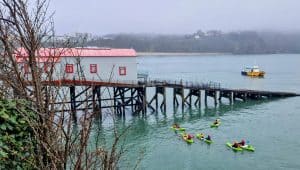 ing under the headland’s cliff face where the rock is streaked orange and green with lichen and the swell lifts and drops the kayak with lazy, satisfying rhythm.
Round the headland and you pass two generations of lifeboat station — old and new, almost side by side. The older station, built in 1905 and perched dramatically above a slipway on the northern face of Castle Hill, launched lifeboats down wooden runners to the water for a hundred years before finally being replaced. It became famous in a different way when it was later converted into a private home and featured on Channel 4’s Grand Designs — the kind of renovation project that makes architects weep with envy and builders weep for entirely different reasons. The modern station alongside it, completed in 2005 at a cost of £6.5 million, houses the Haydn Miller, a Tamar-class all-weather lifeboat that was the first of its class to enter operational service in the UK.
North Beach: The Famous View
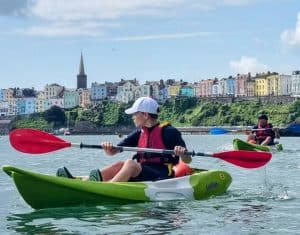
Clear the headland and North Beach opens up ahead of you. The view from the water is one of the finest in Wales, and from a kayak you get the low, intimate angle that no clifftop photograph can replicate. The row of Georgian townhouses above the beach — pastel facades in peach,cream, yellow, and terracotta, stacked five storeys against the sky — have been replicated on more tourist merchandise than any other view in Wales and look even better from the sea. The beach itself is long, east-facing, and beautifully sheltered, the pale sand catching the morning light and the water running clear over the limestone bedrock offshore.
The Cliffs North of Tenby: A Different World
As you pass the northern end of the beach the town falls behind and the geology changes entirely beneath your hull. The limestone that formed Castle Hill and St Catherine’s Island — pale, fossiliferous, deposited in a warm tropical sea 350 million years ago — is left behind as you cross the Ritec Fault, one of the major geological boundaries in south Wales. To the north the cliffs are darker, more layered, composed of mudstones, shales, siltstones and sandstones laid down roughly 312–320 million years ago: the Millstone Grit and lower Coal Measures of the western South Wales Coalfield.
This is an extraordinarily significant stretch of geology. The cliffs between Tenby and Saundersfoot represent the westernmost exposure of the south crop of the South Wales Coalfield — rocks that have been studied by geologists since the 19th century and which yield some of the finest Carboniferous plant fossil assemblages in Britain. Fern fronds and lycopod trees pressed into dark mudstone, preserved from a time when this coast was a vast river delta on an equatorial continent. The coal seams traceable through this sequence were actively mined just up the coast at Saundersfoot into the 20th century. Industrial Wales, in miniature, written in the cliffs above your head.
The cliff faces are rich habitat too. Fulmars — stocky, pale seabirds more closely related to albatrosses than gulls — nest on the ledges and soar the cliff thermals with barely a wingbeat. Treat them with respect: when disturbed at the nest, they defend themselves by projecting a jet of foul-smelling stomach oil that can travel more than a metre. You have been warned.
First and Second Point: Wrecks and History
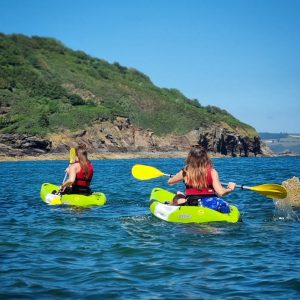 The towering headlands north of Tenby are known locally as First Point and Second Point, and this stretch of water has deep maritime history. Pembrokeshire’s coast sits on one of the historic main shipping lanes between the Atlantic and the Bristol Channel, and over the centuries the combination of fierce tidal races, unpredictable weather, and treacherous submerged rocks has claimed countless vessels. The Great Storm of November 1703 — one of the most destructive weather events in British recorded history — wrecked an estimated 150 ships off the Welsh coast alone in a single night. When you paddle over these headlands, the water below you is not empty.
Our Secret Beach
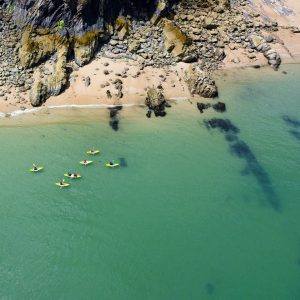
Just over a mile north of Tenby, tucked into the cliffs and invisible from land unless you know exactly where to look, lies Brownslade Bay.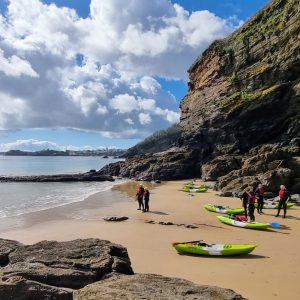 Accessible only by a 200 foot abseil from the clifftop, or — more elegantly — by kayak, it’s a small shingle and sand cove backed by spectacular cliffs with views south to Tenby and the familiar outline of Caldey Island across the water. It disappears entirely at high tide, making it one of the more exclusive beaches in Wales.
If conditions allow, this is where we stop. Kayaks pulled up on the sand, life jackets off, everyone horizontal on the warm stones with snacks and whatever the guide has thought to provide — which is usually something better than you’d expect. The guide will use this moment to share the remarkable history of the bay: that this quiet coast was used as a landing point by the Scottish privateer John Paul Jones, who — depending on which account you read — was either a celebrated founding father of the American Navy or a straight-up pirate, and who found nearby Waterwynch a useful and discreet anchorage during his activities off the Welsh coast in the 1770s. You may form your own view. Take your time here. The journey back has some of the best bits still ahead.
The Return: Offshore, Eyes Open
The return leg takes an offshore route, pulling further out from the cliffs where the water deepens and the swell runs clean and unobstructed. This is the stretch where, if you’re going to see harbour porpoises, you’re most likely to see them. Small, dark, and fast, they move in tight arcs just below the surface — a roll of back and fin and then gone, reappearing fifty metres away in a direction you weren’t expecting. Carmarthen Bay is designated a Special Area of Conservation partly for its cetacean populations, and on the right day the sea here feels genuinely alive. Seals will often swing by to investigate us too, here’s a young grey seal wondering what we might be:
The Caves: St Catherine’s in the Right Tide
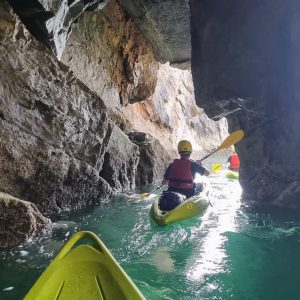 The final flourish, if the tide cooperates, is the sea caves of St Catherine’s Island. The island is riddled with them — three principal caverns penetrate entirely through the limestone in places, carved over millennia by the patient work of the Atlantic swell. At the right state of tide you can paddle into them, the light changing from bright white to green to a deep inky blue as the rock closes overhead, the sound of water transforming into something hollow and resonant, the outside world reduced to a bright rectangle behind you. It is one of those experiences that makes people go very quiet. Cave access depends on swell, wind, and tide height, and your guide will make the call on the day.
Back on Castle Beach: The Dennis Cafe
Castle Beach. Kayaks dragged up the sand, kit stripped off, hands slightly stiff and the particular satisfied tiredness that comes from using muscles you’d forgotten you had.
The Dennis Cafe sits just above the beach at Castle Sands, open April to October, with window seats looking directly out to St Catherine’s Island and the water you’ve just come back from. The coffee is good, the cake is better, and the view makes both of them taste even better than they are. It is an excellent place to sit in the sun and talk about what you saw, what you felt, and when you’re coming back.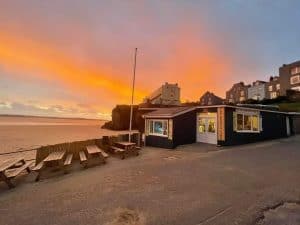
Book a sea kayaking session with Tenby Adventure →
From £55 per person. All equipment provided. No experience necessary.