
Give a child a rock pool and twenty minutes and something happens that’s hard to achieve with a whiteboard and an overhead projector. They crouch, go quiet and discover that a limpet, politely asked to move, will decline; the anemone they are watching has noticed them too. Somewhere at the back of the mind a small door opens on the idea that the world is bigger, stranger and considerably wetter than the one indoors.
That is more or less the whole argument for Pembrokeshire Beach School. But “trust us, it’s good for them” is what every provider of everything says, so here’s the research. Some of it is striking. Some of it is suggestive rather than conclusive. Have a read and make your own mind up:

The shrinking map of childhood
Ask anyone over forty where they played as a child and you might well get a map: the lane, the stream, the field with the bull in it that everyone swore was dangerous. Ask a child today and the map is often a lot smaller.
This is not nostalgia talking. The Policy Studies Institute has been measuring it since 1971. In that year 86% of primary school children in England were allowed to travel home from school on their own. By 2010 the figure was 25% (Shaw et al., 2013). A decade later the British Children’s Play Survey asked 1,919 parents the same sort of question in a different way. Their children were, on average, nearly 11 before they were allowed out to play alone. The parents themselves had been let loose before they turned 9 (Dodd et al., 2021).
The most recent figures come from Natural England, which surveys around 4,000 children aged 8 to 15 every year. In 2025, 93% of them agreed that being in nature makes them very happy. Yet in term time, outside school hours, only 43% had spent time in outdoor places beyond their own garden on most days of the week (Natural England, 2025). Those are English figures – nobody runs quite the same survey in Wales – but there is little reason to suppose things are different this side of Offa’s Dyke.
None of this is an accusation. The roads are busier, family diaries are fuller and the sofa has never been more persuasive. Parents are not being foolish. But add it all up and you get a generation that loves the outdoors in principle and sees rather less of it in practice.
What the research actually says
Two hours a week
The best-known number in this field is 120. Researchers at the University of Exeter looked at 19,806 people in England and found that those who had spent at least two hours in nature during the previous week were noticeably more likely to report good health and high wellbeing than those who had spent none. It did not matter whether the two hours came in one lump or in several shorter visits (White et al., 2019). The study was of adults, but two hours is a useful yardstick for a family – it’s one decent morning on a beach.
Attention, learning and the classroom walls
Closer to home, a Swansea University team followed three primary schools in South Wales as they began teaching part of the ordinary curriculum outdoors for at least an hour a week. Pupils aged 9 to 11 talked about a sense of freedom and said they felt more engaged with what they were learning. Their teachers, some of whom had started out sceptical, reported better job satisfaction (Marchant et al., 2019). It is a small study built on interviews rather than test scores. It does, however, match what the Welsh Government’s own curriculum guidance now says about learning outdoors: that it can bring high levels of wellbeing, confidence and engagement (Natural Resources Wales).
Eyes that can see the horizon
The sturdiest piece of evidence on this page has nothing to do with happiness. In Guangzhou, China, twelve primary schools were randomly split into two groups. Six carried on as normal while the other six added a single 40-minute outdoor class to every school day. Three years later 39.5% of the children in the ordinary schools had become short-sighted, against 30.4% in the outdoor schools (He et al., 2015). This was a randomised trial of about 1,900 six-year-olds, which is as close to proof as this kind of research gets. Bright daylight appears to help a growing eye keep its shape and a beach has plenty of it, even in November.

In praise of dirt
In Finland, researchers took the gravel yards of city daycare centres and covered part of them with forest floor and turf. After 28 days the children who played there had a richer mix of bacteria on their skin and in their gut than children in unaltered yards, along with shifts in the blood markers that suggest a better-regulated immune system (Roslund et al., 2020). It was a small study of 75 children, in a forest rather than on a foreshore. But it is one of the first experiments to test what grandparents have always suspected about a bit of muck.
A sensible amount of risk
Researchers use the phrase “risky play” for the things children have always done when left to it: climbing, balancing, going a little too fast, wandering just out of sight. A Canadian-led review pulled together 21 studies on the subject and found the overall effects on children’s health to be positive, with more physical activity and better social skills among them (Brussoni et al., 2015). The authors were candid that the underlying evidence ranged from very low to moderate in quality. Their conclusion was nonetheless that children need more of this, not less. A rock with a parent three feet away is a rather good place to start.

Why the beach in particular
Most of the research on children and nature has been done among trees. Forest school has a head start of some decades and a literature to match. The seashore has had less attention, which is odd given how much of Britain is edge.
What there is points the same way. A team spanning Exeter, Vienna and Rome surveyed 15,743 adults across 18 countries and asked them to think back to their first sixteen years: how often they went to the sea, a river or a lake and how relaxed their parents were about them playing there. Those who remembered more of it placed a higher value on nature as adults, visited it more often and reported better wellbeing. The pattern held up broadly across all 18 countries (Vitale et al., 2022).
One of the authors made a point that any coasteering guide would second. Water can be dangerous for children and parents are right to be careful around it. But the answer the research suggests is not to keep children away – it’s to help them become comfortable and competent there early, since familiarity bred in childhood seems to last.
Then there are the things no study has needed to measure. A woodland changes with the seasons, a beach changes twice a day. The tide wipes the classroom clean and restocks it every six hours or so, which means nobody ever has quite the same lesson twice. There is sand to dig, water to dam, a strandline to pick through and a horizon to stare at. Nothing on it is plugged in.
What the evidence cannot tell you
It would be easy to stop there and let the numbers do the selling, but they deserve a few caveats first.
Most of these studies show that two things go together, not that one causes the other. Families who spend time outdoors may differ from those who don’t in all sorts of ways that also affect health and happiness. The two-hour study was of adults. The blue space study relied on grown-ups remembering their childhoods, which is not the most reliable instrument known to science. The Finnish children were playing on forest floor, not sand. The eyesight trial is the only large study here that randomly assigned children to more time outside and then waited to see what happened.
Beach school itself has barely been studied. Researchers at Edge Hill University, who work with a network of beach schools on the north-west coastline of England, have said plainly that there is little published evidence on it yet (Edge Hill University, 2022). So nobody can honestly promise that a Saturday morning at Manorbier will improve your child’s spelling.
What can be said is this: the findings come from different countries, different decades and different kinds of study but they all lean the same way. The cost of acting on them is small and the worst plausible side effect is a pair of wet socks.
So we started a beach school
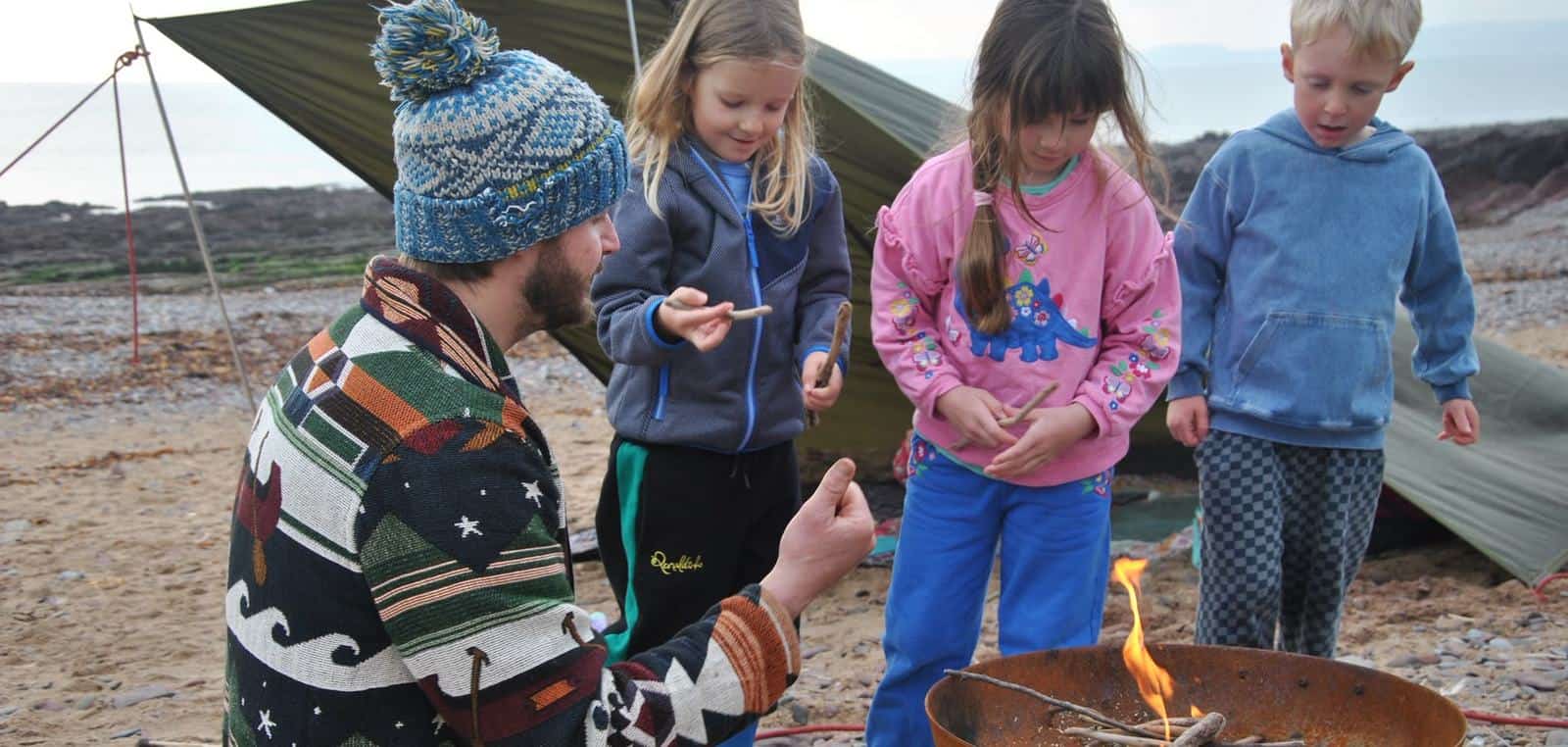
Pembrokeshire Beach School is our small contribution to making the map bigger again. It runs on the beach at Manorbier, below the castle, for children aged 5 and up with a parent or carer alongside. Younger brothers and sisters are welcome to tag along under their own adult’s eye.

It is led by Tom, who has guided on this coastline for fifteen years, the last ten of them full-time. He has led our coasteering and kayaking and has also delivered our schools activities, including beach bushcraft and educational sessions. He is an expedition leader and outdoor first aid trainer, DBS checked and registered with the Education Workforce Council. In that time he has built up a broad knowledge of the shore and an enthusiasm for it that he is keen to pass on to adults and children alike. No two sessions are the same, partly by design and partly because the beach never offers the same thing twice. One week might be storytelling and strandline treasure while another might be rock pools, shelters or whatever the last spring tide left behind.
Beach School costs £20 per child. Adults come free, since the research rather suggests you need it as much as they do. Hot chocolate, marshmallows and fireside snacks are usually included. There are no screens, no worksheets and no wrong answers, though there may be a limpet with firm views.
The Exeter researchers put the figure at two hours a week and we can help with at least some of them.
References
- Brussoni, M. et al. (2015). What is the relationship between risky outdoor play and health in children? A systematic review. International Journal of Environmental Research and Public Health, 12(6), 6423-6454. Link
- Dodd, H.F., FitzGibbon, L., Watson, B.E. and Nesbit, R.J. (2021). Children’s play and independent mobility in 2020: results from the British Children’s Play Survey. International Journal of Environmental Research and Public Health, 18(8), 4334. Link
- Edge Hill University (2022). Interview on beach school research. Link
- He, M. et al. (2015). Effect of time spent outdoors at school on the development of myopia among children in China: a randomized clinical trial. JAMA, 314(11), 1142-1148. Link
- Marchant, E. et al. (2019). Curriculum-based outdoor learning for children aged 9-11: a qualitative analysis of pupils’ and teachers’ views. PLOS ONE, 14(5), e0212242. Link
- Natural England (2025). The Children’s People and Nature Survey for England: 2025 update. Link
- Natural Resources Wales. Increased role for outdoor learning and natural environment in new school curriculum. Link
- Roslund, M.I. et al. (2020). Biodiversity intervention enhances immune regulation and health-associated commensal microbiota among daycare children. Science Advances, 6(42), eaba2578. Link
- Shaw, B. et al. (2013). Children’s independent mobility: a comparative study in England and Germany (1971-2010). Policy Studies Institute. Link
- Vitale, V. et al. (2022). Mechanisms underlying childhood exposure to blue spaces and adult subjective well-being: an 18-country analysis. Journal of Environmental Psychology, 84, 101876. Link
- White, M.P. et al. (2019). Spending at least 120 minutes a week in nature is associated with good health and wellbeing. Scientific Reports, 9, 7730. Link