






Four years ago we stumbled into a sea cave on the South Pembrokeshire coast and found something we weren’t expecting: bats. This week, we went back with the same ecologists who confirmed the find in 2022. The news is good – and there’s more.
Why we returned
When we first wrote about the bats in 2022, we were coasteering guides who’d had a lucky discovery. We logged what we saw, reported it to the ecologists – the incredibly knowledgable Ecoleg, based in Cardiff. Which is exactly what the law requires. In the UK, every bat species and every roost is protected under the Wildlife and Countryside Act 1981 and the Conservation of Habitats and Species Regulations 2017. You don’t just “pop back for a look”. Roost surveys need a licence from Natural Resources Wales, specialist equipment, and people who know what they’re doing.
This year, a local ecologist agreed to go back in with us. While they were at it, we also scoped three other caves along the coast that looked, from a coasteering guide’s eye, like promising roost habitat – large, dry, dark chambers with stable temperatures and good flight access. The ecologist led the way. We mostly carried their kit.
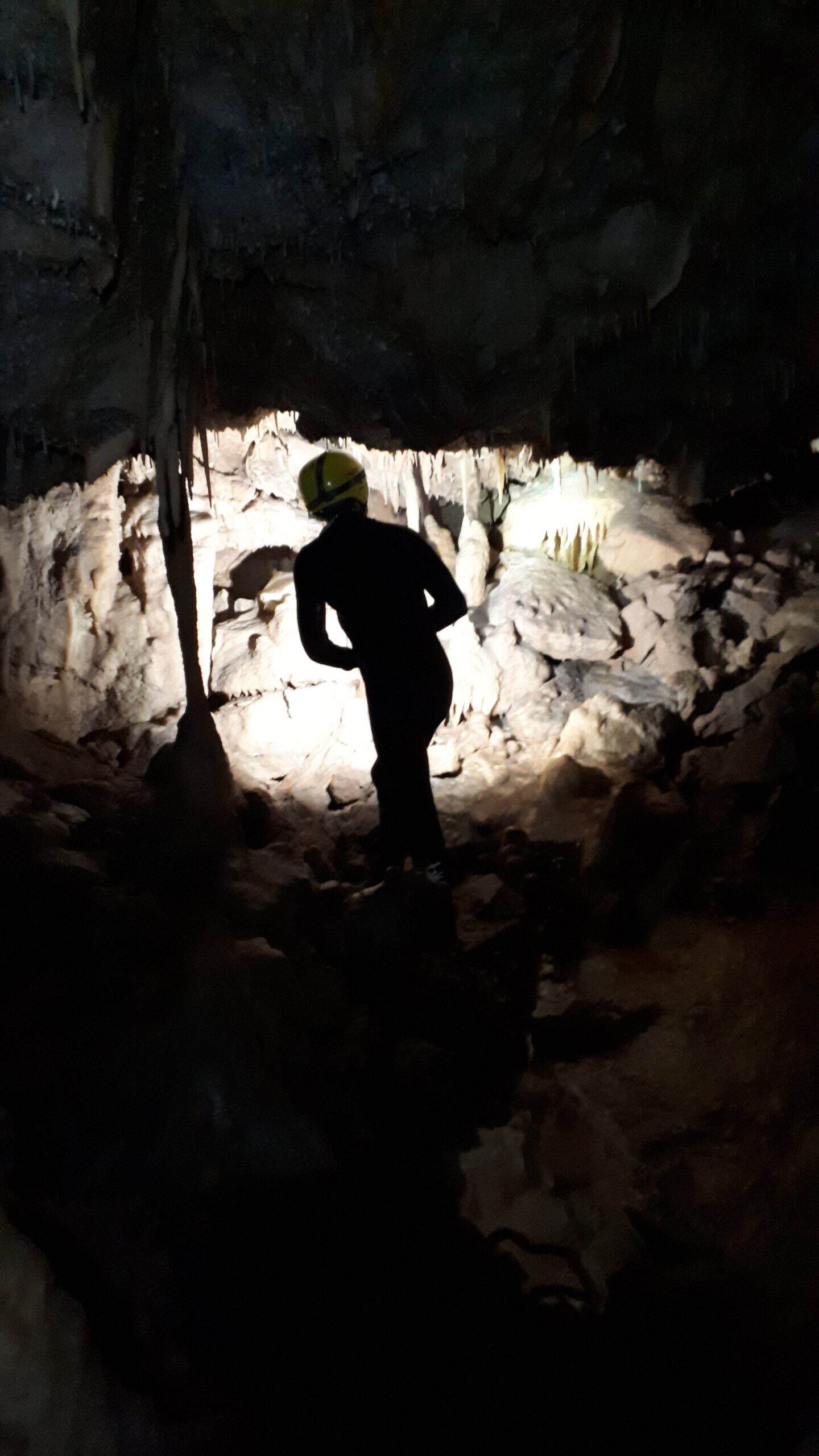
Cave reconnaissance on the South Pembrokeshire coast.
The outcome matters beyond the bats themselves. The original roost has now been formally added to the site guidance in the Pembrokeshire Coasteering Concordat – the voluntary agreement under which every commercial coasteering provider in Pembrokeshire operates on National Trust, Pembrokeshire Coast National Park and Pembrokeshire County Council land. That means every other operator in the county now has the same information we do, and the same obligation to keep the site undisturbed. This is how voluntary self-regulation is meant to work: one operator flags something, specialists confirm it, and the protection propagates across the whole industry without a single statutory licence being issued.
What follows is what we’re comfortable sharing publicly. Specific locations have been withheld for reasons that will make sense by the end of the post.
The original roost: numbers are up
The bats we found in 2022 are still there. More importantly, there are visibly more of them. The ecologists’ count came in significantly higher than our rough 2022 estimate – and while a single repeat count isn’t a population trend, it’s encouraging. The species composition also matches what we’d suspected: this is a mixed-species roost with horseshoe bats present, and Pembrokeshire’s horseshoe bat population is a big deal in UK conservation terms.
Three more caves, surveyed properly
Of the three other sites we explored, two showed clear signs of bat use – droppings, grease staining on the walls at roost height, and acoustic detector hits during a dusk emergence watch. The third cave showed no current activity but the habitat was suitable; it’s the kind of site that might be used transitionally, between summer roosts and winter hibernacula. The ecologist wants to return in autumn and again in midwinter before drawing any conclusions. The two confirmed sites will, in due course, join the original roost in the Concordat’s site guidance – extending a small amount of hard-won knowledge across the whole industry.
This is the bit that surprised us as laypeople: bats don’t just live in one cave. Horseshoe bats in particular move between multiple roosts across the year – a warm summer nursery, a cooler autumn swarming and mating site, and a cold winter hibernaculum. A single bat might use four or five different underground sites over twelve months. Counting the population at just one of them tells you very little. That’s why ecologists are so careful about returning repeatedly across seasons, and why the Pembrokeshire coast, with its hundreds of caves and fissures, is so important to these animals.
The Cavern of Ming
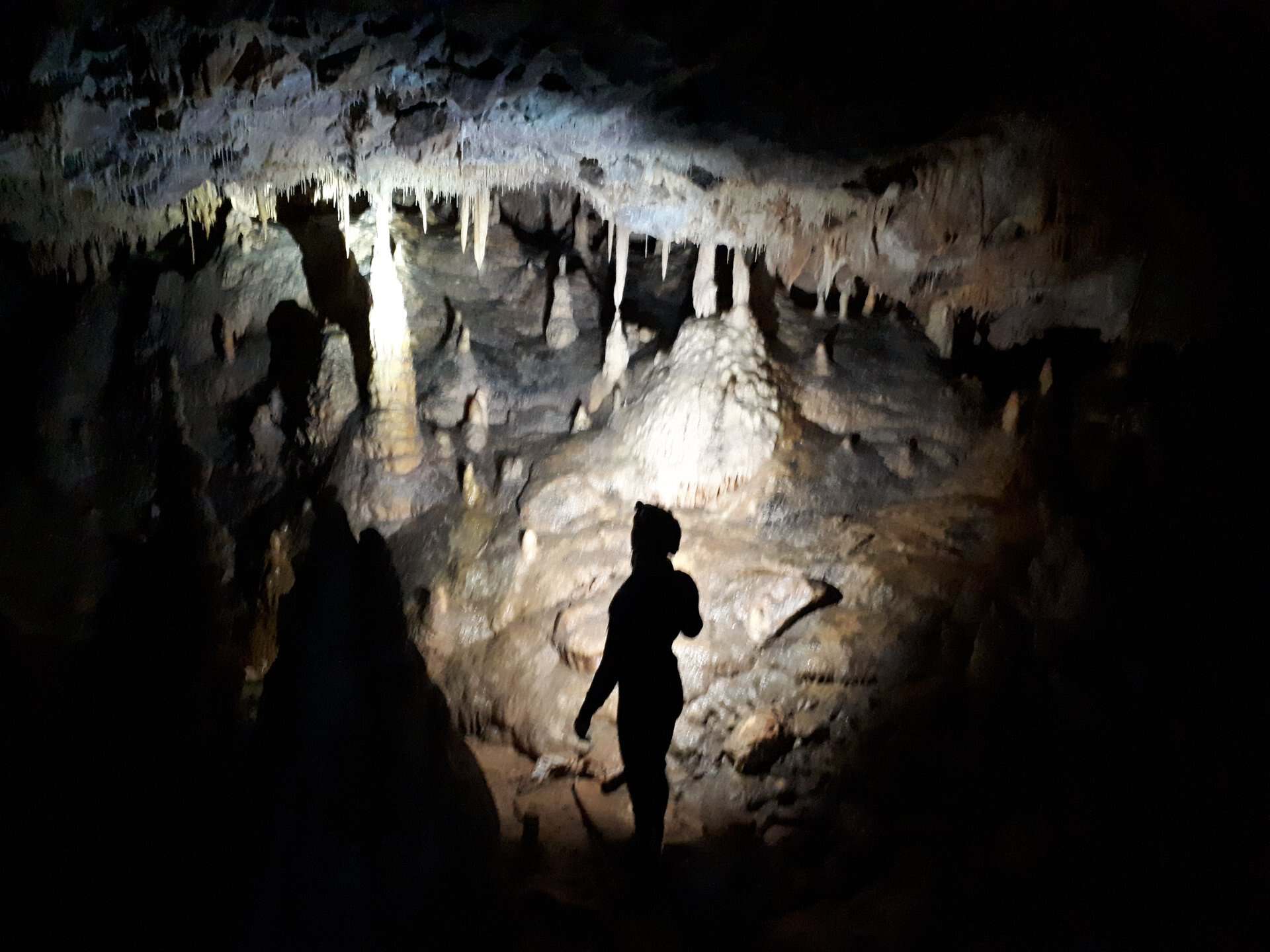
Inside a Pembrokeshire coastal cave – stalactites and stalagmites formed over tens of thousands of years.
On the last day of the survey week, we pushed into a cave that none of us had been into before: The Cavern of Ming – that’s not the official name for it. A more formal description: a sea-level entrance which leads into a sloping tunnel rising back and upward to a chamber about five metres above the high-water mark, beyond the reach of any tide.
That chamber has a freshwater pool. It has stalactites and stalagmites. And – to our knowledge – it’s unrecorded in the cave surveys we’ve been able to find.
The geology makes sense once you see the layout. The entrance is wave-formed and marine, but the main chamber sits well above sea level and is fed instead by freshwater percolating through the Carboniferous Limestone cliffs above. That freshwater, saturated with dissolved calcium carbonate after its slow journey through the rock, is what deposits the speleothems – the technical name for stalactites and stalagmites – given enough time and undisturbed conditions. The freshwater pool is almost certainly a resurgence: groundwater emerging from the limestone above the tidal zone, pooling where it finds a floor. This isn’t really a sea cave in the classical sense, then. It’s a karst cave with a marine entrance – the sea hasn’t drowned it, just given it a dramatic door. That configuration is rare enough to be genuinely interesting.
We’re not claiming a discovery – Pembrokeshire’s coastal caves have been explored by the South Wales Caving Club and coastal explorers for decades, and the odds that four TA guides have found something genuinely new are slim. What we can say is that the cave appears unrecorded, and we’ll report it formally to the South Wales Caving Club. If it’s already catalogued under another name, great. If it isn’t, the scientific record gains an entry – and any bat use it turns out to host gains the legal protection that public recording triggers.
Did it have bats? Yes. We’re not going to tell you more than that.
Why Pembrokeshire matters for bats
If you grew up associating bats with horror films, you probably haven’t had the pleasure of actually watching one fly. They are astonishing animals – the only mammals capable of true powered flight, navigating in pitch darkness by emitting sound and reading its echoes, capable of catching a moth the size of a fingernail out of the air at full speed. The UK has seventeen resident species, and Pembrokeshire is home to more of them than most counties in Britain.
One species in particular makes Pembrokeshire internationally important for bat conservation: the Greater Horseshoe bat.
The Greater Horseshoe bat – why it matters here
- One of the UK’s rarest mammals. Total UK population is estimated at around 13,000 individuals – fewer than the number of people who live in Tenby in August.
- Pembrokeshire is a stronghold. Around 9.5% of the entire UK Greater Horseshoe population lives here, making the county one of only three core regional hubs alongside Devon and the Mendips. The nursery roosts at Stackpole and Slebech are designated as a Special Area of Conservation.
- Range collapse. The species has lost over 90% of its UK range since 1900. It’s currently classed as Near Threatened in Wales.
- Built like a tiny aircraft. Body 5-7 cm long, wingspan 35-40 cm, weight 17-34 g. Despite that, they can live for up to 30 years – the longest-lived bat species in Britain.
- A unique horseshoe-shaped nose-leaf – a flap of skin around the nostrils that focuses echolocation calls at a constant 82 kHz, well above human hearing.
- They hunt by perching and pouncing, waiting on a branch or rafter for a beetle or moth to pass and then snatching it on a short flight, rather than chasing insects around like pipistrelles do.
- They wrap their wings around themselves like a cloak when roosting – unlike most UK bats, which tuck into crevices.
Other species likely to be using Pembrokeshire’s coastal caves include the Lesser Horseshoe (a smaller cousin, still found here in meaningful numbers), Daubenton’s bat (a water-specialist that hunts insects skimmed off the surface of sea lochs, estuaries and sheltered coves), Natterer’s, Brown Long-eared, and both species of pipistrelle. Different species use different caves, different seasons, and different parts of the same cave. It’s a whole underground ecosystem stacked above the tide line, and most people walking the coast path have no idea it’s there.
A brief glimpse – filmed at a separate, non-commercial site on the South Pembrokeshire coast.
What we’re not sharing – and why
You’ll notice we haven’t named a single cave in this article. That’s deliberate. Natural Resources Wales explicitly withholds bat roost locations from public datasets because disclosure risks disturbance – by well-meaning naturalists, by photographers, by people who just want to see something cool, and occasionally by people with worse motives. A single disturbed hibernation can kill a whole cluster of bats: waking a hibernating bat costs it weeks’ worth of fat reserves it doesn’t have to spare.
The bats are there because nobody bothers them. We’d like to keep it that way.
If you’re a genuinely curious reader and you want to see Pembrokeshire bats properly, the right way is through the Bat Conservation Trust’s guided walks, local wildlife trust events, or – if you’re really keen – by getting involved in the National Bat Monitoring Programme as a volunteer. You’ll see far more bats, far better, in the company of people who know what they’re doing.
What this means for our coasteering
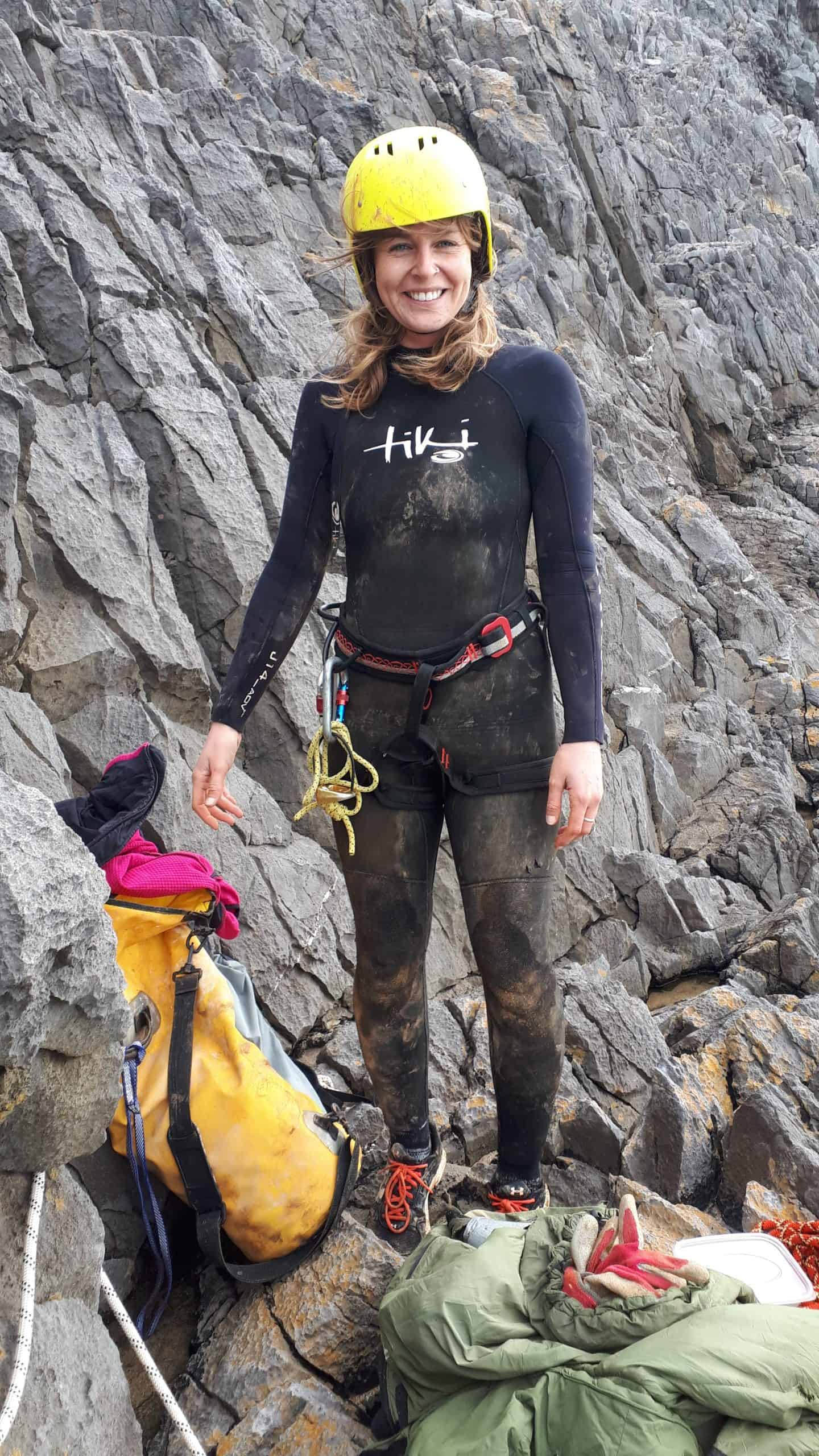
Josie, post-cave, back on the Pembrokeshire coastline.
One question we’ve been asked before: does Tenby Adventure run coasteering trips into these caves? No. Our sessions run on cliffs, platforms, gullies and in sea caves where we can safely manage groups, and within the site guidance laid down by the Coasteering Concordat. The caves we survey for bats are separate – accessed on reconnaissance trips, with ecologists, under licence where required. Sensitive sites identified through this process feed straight back into the Concordat’s guidance for every operator in Pembrokeshire, not just ours.
What our guides do bring to coasteering sessions and sea kayaking trips is the knowledge built up on these trips – the geology, the wildlife, the stories of what’s in the cliffs behind you when you’re floating in the swell looking up. A coasteering session is a few hours in the water. A good guide turns it into an education about one of the most interesting coastlines in Europe.
What’s next
The ecologists will return in autumn to survey the cave showing transitional habitat, and again in January for hibernation counts. We’ll do a follow-up post when they share what they’re willing to share. In the meantime, the Bat Conservation Trust’s website is the best resource we know of for anyone who wants to learn more – and if you find a bat in distress, their National Bat Helpline is the number to call.
We’ll leave you with one thought. The Pembrokeshire coast, seen in daylight from a coasteering session, is spectacular. Seen at dusk in June, with horseshoe bats emerging from the cliffs you’ve just been climbing on, it’s a different kind of spectacular altogether. There’s a lot more going on down there than most people ever notice.
Get in touch to plan a session.