






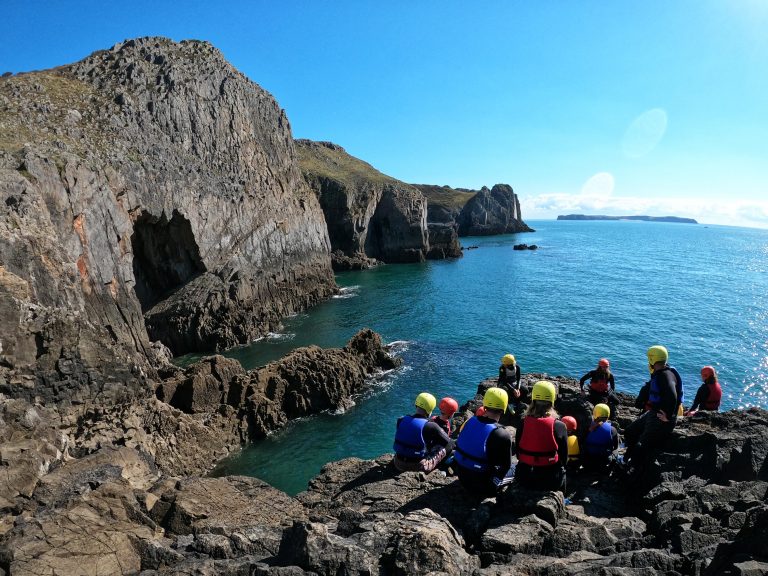
Lydstep is the headline route for coasteering near Tenby. Ten minutes’ drive from the town centre, a free car park that’s usually quiet, a stretch of epic limestone headland riddled with caves, traverses and jumps — it’s our favourite venue, hands-down. We think it’s THE best coasteering venue in Wales. This is the practical guide: what Lydstep is, how to get there, what a session looks like, when conditions are best, and what to expect.
Where Lydstep is and how to get there
Lydstep Headland is on the south Pembrokeshire coast between Tenby and Manorbier, about four miles west of Tenby. From Tenby it’s a 10-minute drive on the A4139. From Pembroke and the west you’re looking at 20–25 minutes. The meet point is a National Trust car park — free, normally has plenty of space even on summer Saturdays, and the start of the coasteer is a two-minute walk from there.
If you’re staying in Tenby town itself, there is a bus from the town-center. We send detailed directions and meet-point pin in your booking confirmation. The headland is an adventurous location (!) has no facilities (no toilets, no shop, no shelter), so plan accordingly.
Why Lydstep works for coasteering
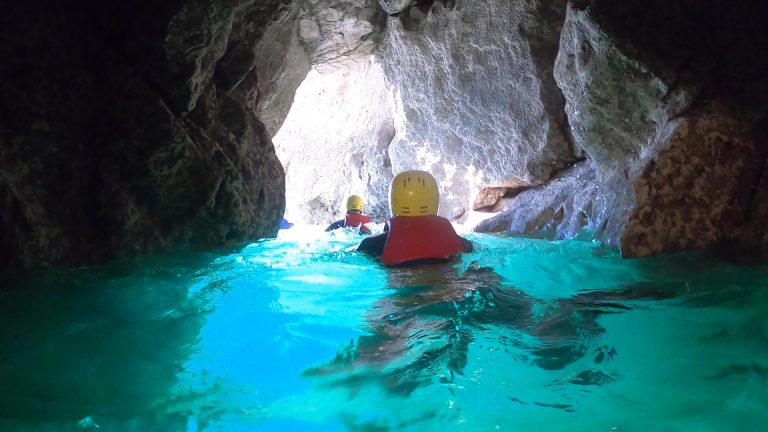
Limestone geology is what makes the headland good for this. The dramatic caves of Caverns, the sheltered jumps at Black Rock, the wonders of Cheeseland and the fascinating strata of the Harbour are all products of millions of years of immense forces shaping the coastline. Over thousands of years the tectonically up-lifted geology has formed sea caves, arches, sheltered coves and a network of low-level traverses that connect them. The cliffs are over 150ft and spectacular (you won’t be jumping from that height though!). There are cave swims, jumps, surfy play-spots and sheltered sections for catching breath, and route choices that adapt to the conditions on the day.
The headland faces south, which means the routes get the sun for most of the day and are sheltered from cold northerly winds.
What a session looks like
A typical session is 2.5 to 3 hours start to finish. You arrive at the car park, we hand out wetsuits, helmets and buoyancy aids, and there’s a short brief covering safety, jump technique and the basics of how to move safely along the rock. From there it’s about a five-minute walk to the entry point.
Group sizes are kept small — usually six to eight participants per guide or ten to twelve if our guide has an assistant. The route is tailored on the day to who’s in the group and what conditions are doing. A nervous family of four with younger kids gets a different route than four confident teenagers; the guide reads it. Jumps are always optional. The same applies to caves — anyone uncomfortable in dark or enclosed spaces can sit the cave swims out safely.
Who it’s for — and who it isn’t
Minimum age is 8. There’s no formal maximum but the route involves a fair amount of scrambling, swimming and climbing in and out of the water, so a reasonable level of mobility helps. Confident swimmers do better than beginner swimmers, the buoyancy aid does some of the heavy lifting in the water but you do need some swimming ability. We run sessions for groups who’d describe themselves as “not great swimmers” regularly though. Wetsuits are 5mm which keeps you warm even in May; thermally you’ll be fine almost any time of year.
What you actually get on the day depends on your group, the conditions, and what you tell us you’re up for. At one end of the range, Lydstep delivers a guided cruise through sea caves with optional small jumps, pitched at the average person on a family holiday. At the other end, the same headland has more and better jumps than most coasteering venues in Pembrokeshire and can deliver a genuinely full-on “beast” coasteer — bigger jumps, longer routes, more committing line choices — for groups who want to be pushed. Your guide will tailor.
When conditions are best
Late April to October is the working season. Sea temperatures are comfortable in 5mm wetsuits from late April onwards. Peak conditions are typically late May through September — warm water, long days, sheltered routes available even when summer storms roll through. We run in most weather short of an actual storm; light rain doesn’t stop a session that’s already in the sea.
Tide-wise, the routes change with the state of the tide. Some caves are accessible only at lower water; some traverses only work at higher water. You don’t need to know any of this when booking — we plan the route around the tide times for your session — but it’s why two coasteers at “the same place” can feel quite different depending on when you go.
What to bring (and what we provide)
We provide: wetsuit, helmet, buoyancy aid, guide, the route plan, and a thorough safety brief. You bring: old trainers or beach shoes with grip (don’t wear flip-flops — they don’t stay on), a swimming costume or shorts to wear under the wetsuit, a towel, and warm dry layers for after. If you want photos on the water, a waterproof phone case or GoPro works well; without one, leave your phone in the car.
Book your Lydstep coasteer
If you’d like to book, head over to our coasteering page for current dates, prices and the booking widget. Adult sessions £55, kids £45. School holiday weeks book up two or three weeks ahead. If you’re coming during May half-term, our May Half-Term 2026 family guide covers the wider Tenby week — and the HALFTERM code gets you 5% off any session that week.
Frequently asked questions
How long does a Lydstep coasteer take?
Around 2.5 to 3 hours from car park to dry clothes, including kitting up, brief, the session itself, and changing afterwards. Most of that time is in the water or moving along the coast.
Is the Lydstep car park free?
Yes. The National Trust car park we meet you at is free and rarely full even during peak season weekends. We send you the pin in your booking confirmation.
What’s the minimum age for Lydstep coasteering?
Eight years old. Children younger than eight aren’t able to take part for safety and group-pace reasons. There’s no formal upper age limit — we’ve taken plenty of confident over-60s out — but a reasonable level of mobility helps with the scrambling.
Do I need to be a strong swimmer?
You don’t need to be an Ironman swimmer, but being happy and relaxed in the water is a good idea! We generally suggest that you can swim 25m confidently. You ARE wearing a buoyancy aid but you need to be able to move through the water to make progress over parts of the route.
What happens if the weather’s bad?
We run in most conditions. Rain doesn’t stop a coasteer; you’re already wet. Wind direction can be a factor — some routes don’t work well in southerly swell — but Lydstep faces south-southwest, which means it stays workable when many Pembrokeshire venues don’t. We only cancel for genuine safety reasons (e.g. major storm), and we’ll reschedule for free or refund.
Can I jump off cliffs?
Yes, if you want to. Jumps are always optional and graded — your guide will talk you through technique and let you choose your height. Lydstep has some of the best variety of jumps of any coasteering venue in Pembrokeshire, from low warm-ups to committing higher options, with smaller alternatives always available. Nobody’s pushed off anything they’re not happy with.